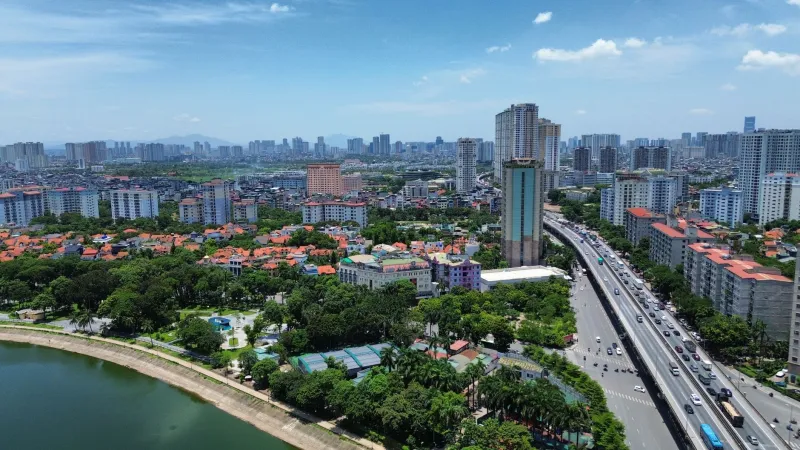
The Landlord's Thesis: Why Steady Rental Income Is Winning the Argument for American Property Owners in Long Bien
American investors have a complicated relationship with the concept of patience. Decades of participation in equity markets conditioned around quarterly earnings cycles, combined with a domestic real estate culture that celebrated the flip as much as the hold, have created a default preference for capital gains over cash flow. Buy low, sell high, repeat. It is a framework that has made many people wealthy — and one that a growing cohort of US property owners in Long Bien is consciously moving away from.
The shift is not ideological. It is mathematical.
The Flip Mentality and Why It Travels Poorly
The buy-and-flip model that worked so effectively in post-recession American markets — particularly in Sun Belt cities during the 2010s — rests on a specific set of conditions: relatively transparent price discovery, liquid secondary markets, predictable transaction costs, and legal frameworks that protect buyer and seller interests with reasonable efficiency.
Applying that model to an emerging Southeast Asian market introduces complications that are not always visible from a distance. Vietnam's property transaction process involves layers of documentation, regulatory considerations for foreign buyers, and a secondary market that, while growing, does not yet offer the liquidity depth of US metropolitan areas. The costs of entry and exit — legal fees, transfer taxes, agent commissions, and currency conversion friction — can meaningfully erode the margins that speculation depends upon.
Rental income, by contrast, requires none of those transactions to recur. Once a property is acquired and tenanted, the income stream operates with considerably less friction. For Americans managing assets from thousands of miles away, this distinction matters.
What the Yield Numbers Actually Look Like
Gross rental yields on well-positioned residential properties in Long Bien have been documented in the 6 to 8 percent range for mid-tier and premium apartment stock — figures that deserve to be placed in context.
The national average gross yield on a single-family rental property in the United States currently sits closer to 4 to 5 percent in most metropolitan markets, with coastal cities frequently delivering sub-3 percent returns after accounting for property taxes, maintenance, and vacancy. Comparable residential yields in established Asian gateway markets — Singapore, Hong Kong, central Bangkok — typically range from 2 to 4 percent.
Long Bien's yield profile, in that context, is not merely competitive. It is exceptional for an asset class that also carries meaningful appreciation potential.
Net yields, of course, require more careful calculation. Property management fees, maintenance reserves, periods of vacancy, and the costs associated with currency conversion and international wire transfers all reduce the take-home figure. Experienced investors in the market typically model net yields in the 4.5 to 6 percent range after accounting for these factors — still a figure that compares favorably to US alternatives on a risk-adjusted basis.
Case Study: A Two-Unit Portfolio in Gia Lam
Consider the experience of a software architect based in Austin, Texas, who acquired two mid-rise apartment units in Long Bien's Gia Lam sub-market in 2021. The combined purchase price, converted at the exchange rate prevailing at closing, represented an investment equivalent to approximately $185,000 USD — a figure that, in Austin's market, would not have secured a single-bedroom condominium.
Both units were tenanted within six weeks of completion, one to a Vietnamese professional family and one to a South Korean expat couple working for a regional manufacturing firm. Combined monthly rental income, after the local property management company's fee, translated to a net annual return of approximately 5.2 percent on the original investment at the initial exchange rate.
By year three, rental rates had been renegotiated upward by 12 percent, reflecting both inflation and the tightening of quality rental supply in the sub-market. The owner has not visited the properties since the initial purchase trip. The management company handles tenant communication, maintenance coordination, and monthly remittance. The income arrives in his US bank account quarterly.
His stated intention is to hold both units for a minimum of ten years before considering any disposition decision.
The Operational Architecture of Remote Ownership
The question Americans most frequently raise about international rental property is not whether the yields are attractive — the numbers tend to answer that question — but rather how one actually manages an asset from across the Pacific.
Long Bien's growing expatriate economy has generated a corresponding ecosystem of professional services designed to address precisely this concern. English-speaking property management firms with verifiable track records now operate throughout the district. Their standard service packages typically cover tenant sourcing and vetting, lease execution, rent collection, maintenance coordination, and monthly financial reporting. Fees generally range from 8 to 12 percent of collected rent, a cost that most investors absorb comfortably within their yield models.
Technology has further reduced the operational burden. Video walkthroughs, digital lease signing platforms, and international banking infrastructure that supports straightforward remittance to US accounts have collectively made remote ownership significantly more manageable than it was even five years ago.
The critical success factor, consistently cited by experienced owners, is the selection of the management partner. Vetting that relationship — through references, site visits during an initial trip, and clear contractual documentation of responsibilities — is where the operational risk either concentrates or dissipates.
Speculation Has Not Disappeared — It Has Been Repriced
It would be inaccurate to suggest that capital appreciation is no longer a relevant consideration in Long Bien. The district's price trajectory over the past five years demonstrates that appreciation is very much occurring. The more nuanced point is that American investors with a full view of the risk-adjusted landscape are increasingly treating appreciation as a secondary benefit rather than a primary thesis.
This repricing of the speculative argument reflects a maturation in how the market is understood. Early-stage emerging market plays reward those willing to accept illiquidity and uncertainty in exchange for maximum upside. Long Bien has moved beyond that phase. It now offers something arguably more valuable to a certain investor profile: a defensible income stream with appreciation optionality attached.
For Americans accustomed to evaluating real estate through the lens of total return — income plus appreciation — Long Bien's current profile represents a combination that is genuinely difficult to replicate in either the domestic market or in the more mature Asian cities that have already absorbed their primary growth cycles.
The Investor Who Benefits Most
The rental income thesis in Long Bien is not universally applicable. It suits, most naturally, investors with a multi-year time horizon, a tolerance for the administrative realities of cross-border ownership, and a preference for visible, recurring returns over the promise of a future exit premium.
For that profile — and it describes a meaningful segment of the American investor community that has been quietly active in Long Bien — the cash flow argument has not merely won the debate with speculation. It has rendered the debate largely beside the point.