Five Years That Changed Everything: The Data Behind Long Bien's Rise from Overlooked to Unmissable
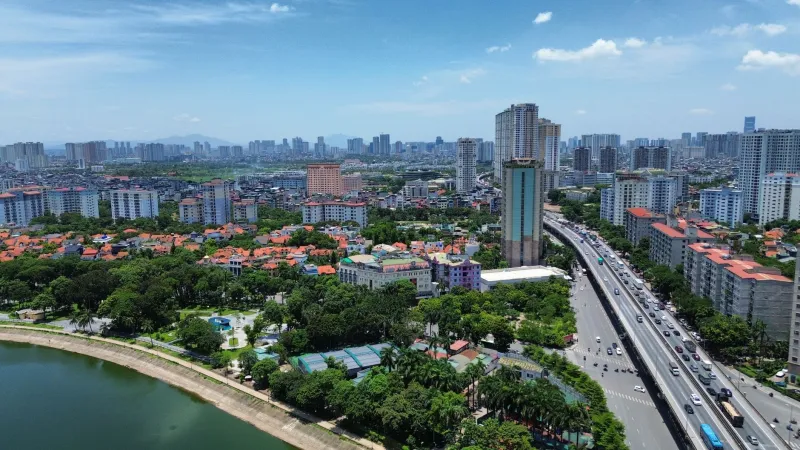
In 2019, Long Bien occupied a peculiar position in the Hanoi property conversation. Locals recognized it as a practical, livable district — well-connected by the iconic Long Bien Bridge and anchored by one of the city's most storied wholesale markets. But for international investors, particularly those arriving from the United States with capital to deploy, it barely registered. The attention, and the premium pricing, belonged to Hoan Kiem, Tay Ho, and the rapidly developing corridors of Cau Giay.
What followed over the next five years represents one of Southeast Asia's more instructive real estate case studies: a district-wide revaluation driven not by hype, but by measurable, compounding fundamentals.
The Baseline: What Long Bien Looked Like Before the Shift
To appreciate the trajectory, it helps to understand the starting point. In the 2018–2019 period, average residential property prices in Long Bien hovered between $1,100 and $1,400 per square meter for mid-tier apartment stock — a meaningful discount of 35 to 45 percent compared to equivalent product in Ba Dinh or Tay Ho. Commercial rents along the district's main arterials were similarly suppressed, reflecting a market that served residents rather than attracting them.
Development activity was modest. A handful of domestic developers had broken ground on mid-rise residential projects, but pre-sale absorption rates were unimpressive by Hanoi standards, and international developer interest was essentially nonexistent. For value-oriented buyers, this was precisely the kind of environment that warranted attention.
2020–2021: Infrastructure as the First Catalyst
The first significant inflection point arrived not through a single headline announcement, but through a series of overlapping infrastructure commitments that began reshaping Long Bien's connectivity profile. Hanoi's urban rail expansion plans — particularly the development timelines associated with metro lines designed to cross the Red River — placed Long Bien directly within the city's future transit spine.
Simultaneously, road improvement programs along the National Highway 5 corridor and the completion of Vinh Tuy Bridge Phase 2 began reducing the friction of moving between Long Bien and central Hanoi. Travel times that had previously discouraged professionals from considering the district for primary residence started compressing in ways that changed the calculus for families and remote workers alike.
For early American buyers who had been tracking infrastructure investment as a leading indicator — a methodology well-established in domestic markets from Nashville to Phoenix — these signals were recognizable. Property inquiries from US-based individuals began climbing, quietly, through 2021.
2022: The Developer Influx and the Price Break
By 2022, the development community had taken notice. A wave of larger-scale residential projects entered the pipeline, several backed by joint ventures with regional capital. Average asking prices for new-build apartments in Long Bien crossed the $1,600 per square meter threshold for the first time, representing a 15 to 20 percent appreciation over the 2019 baseline — in a period that included the global disruption of the COVID-19 pandemic.
More telling than the headline numbers was the shift in product positioning. Developers were no longer marketing Long Bien properties primarily on affordability. Riverside views, proximity to international schools, and the district's comparative spaciousness relative to the cramped central districts were becoming primary selling points. The narrative was changing.
This period also saw the first meaningful wave of American expat professionals — many of them tech workers and entrepreneurs who had relocated to Hanoi during or after the pandemic — signing long-term leases in Long Bien, generating early data on rental yield performance that would later inform investment decisions.
2023–2024: Yield Discovery and the Institutional Acknowledgment
The 2023 and 2024 period marked what analysts might characterize as the yield discovery phase. As rental demand from both the expatriate community and the growing Vietnamese professional class solidified, gross rental yields on well-positioned Long Bien apartments were documented in the 6 to 8 percent range — figures that drew direct comparisons to, and frequently exceeded, returns available in comparable emerging-market residential plays in Southeast Asian cities like Kuala Lumpur or Bangkok.
Perhaps more significantly, this period brought the first institutional acknowledgments. Regional real estate research firms began including Long Bien in formal market reports. Two internationally affiliated property consultancies opened representative offices or assigned dedicated coverage to the district. For American investors familiar with how institutional attention precedes mainstream capital flows, this was a recognizable pattern.
By the end of 2024, average residential prices in established Long Bien sub-markets had reached $1,900 to $2,300 per square meter — representing cumulative appreciation of 65 to 85 percent from 2019 levels, depending on asset class and location within the district.
The Expert View: What the Next Five Years May Deliver
Forecasting in emerging markets carries inherent uncertainty, and responsible analysis demands that caveat. That said, the structural inputs that have driven Long Bien's appreciation to date show limited signs of reversal.
Infrastructure investment continues. The metro timeline, while subject to the delays that characterize large-scale urban transit projects globally, remains on course to materially improve Long Bien's connectivity profile. When operational, analysts project a further demand-side shock to residential property within walkable catchments of station locations — a dynamic well-documented in comparable Asian metro rollouts from Bangkok to Ho Chi Minh City.
Demographic tailwinds are equally durable. Vietnam's expanding professional middle class continues to seek quality residential environments outside the increasingly congested and expensive central districts. Long Bien, with its relative land availability and improving amenity base, sits in a favorable position to absorb that demand.
For American investors considering entry, the honest assessment is this: the period of maximum value obscurity has passed. The period of maximum value realization, however, has not yet arrived. The window between those two phases — where fundamentals are established but mainstream discovery remains incomplete — is historically where disciplined investors generate their most durable returns.
Positioning Ahead of the Curve
The Long Bien story is not finished. It is, by most measures, in its middle chapters. The district's evolution from functional neighborhood to investor-grade market has followed a trajectory that American investors with experience in secondary-market appreciation cycles — whether in domestic Sun Belt cities or international emerging markets — will find structurally familiar.
What distinguishes Long Bien from comparable plays is the compounding nature of its advantages: a capital city location, improving transit infrastructure, genuine lifestyle appeal, and a pricing baseline that, even after five years of appreciation, remains accessible relative to comparable product in established Asian gateway markets.
For those who have been watching, the data makes a compelling case. For those arriving now, the case remains strong — though the window, as windows do, continues to narrow.